
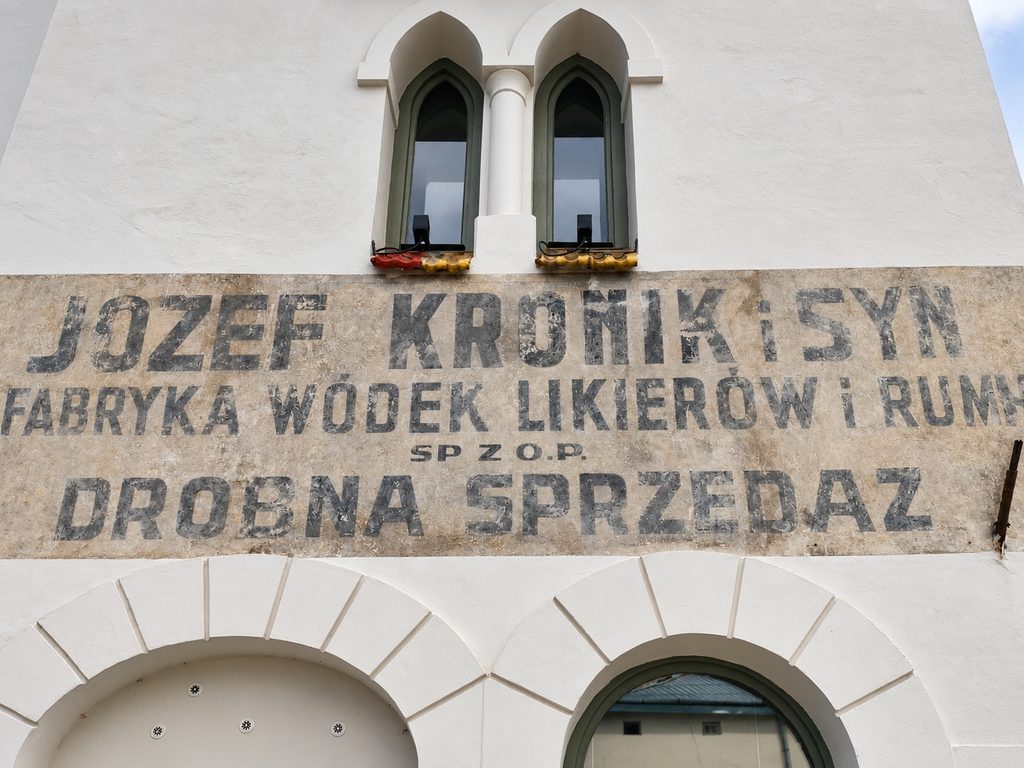
The Jam Factory. That is what most people in Lviv call this complex in Pidzamche. But jam was only made here in Soviet times. For almost a hundred years before that, this place produced rum, liqueurs and sweet rosolis. And it was all made by one Jewish family – the Kroniks.
We are standing at 124 Bohdana Khmelnytskoho Street. The road from Lviv to Zhovkva once ran here, and around it lay the suburb of Znesinnia.
In 1826 the innkeeper Moses Kronik bought a plot of land here. In 1850 he asked the owner of Znesinnia, Franciszka Laszkowska, for permission to open a distillery. He got it: he could make and sell any alcohol except beer and arrack. The fee was 150 florins a year.
His son and grandson carried on the business. The family was a visible part of the Jewish community of Znesinnia: Moses, for example, donated to the Jewish hospital. His son, Leib Kronik, together with other businessmen, bought a plot for the Znesinnia synagogue. And his grandson, Józef, founded a firm under his own name in 1872. It made mainly rum and rosolis. Rosolis is a sweet, fragrant liqueur. It was made, among other things, with rose petals, and in Galicia herbs and fruit were added too.
In 1908 the factory caught fire. The complex was rebuilt – and it came to look more like a romantic castle with a tower than a factory. This is the neo-Gothic building we see today. The look of the factory became part of its reputation as well.
The following year Józef Kronik received the honorary title of Imperial and Royal Purveyor to the Court – recognition from the imperial court in Vienna itself. In 1912 the firm took the name “Józef Kronik i Syn” – Józef Kronik and Son. The son, Moritz Kronik, was a doctor of chemistry. His dissertation at Lviv University dealt with the synthesis of vinegar.
The First World War scattered the family. The Kroniks left for Vienna. In 1915, retreating from Lviv, Russian troops set the factory on fire. But the business revived. In 1926 Moritz returned to Lviv and ran the company together with a partner, Szulim Wallach, a member of the council of the Jewish Religious Community of Lviv.
And here is the most interesting part for us. The firm traded in wine – first Hungarian, later Palestinian. And it specialised more and more in kosher drinks. Slivovitz for Passover, for example. Here the rules of kashrut are no longer theory. Where there are rules, there is demand. Where there is demand, there is production. Jewish food tradition created a whole economy.
And then the story breaks off. In 1939 the Soviet authorities nationalised the factory. During the Nazi occupation most members of the Kronik family were murdered in the Holocaust. The Nazis also destroyed the Znesinnia synagogue that the Kroniks had once helped to fund.
The building survived. In Soviet times wine brought from Moldova and Algeria was bottled here, and later fruit and vegetables were processed and jam was made. Hence the name that has outlived the factory itself.
In 2015 the complex was bought by the Viennese historian Harald Binder. On 18 November 2023 the Jam Factory Art Center opened here. It was built even during the full-scale war, and the factory basement served as a shelter. Today the tower houses a historical exhibition about Znesinnia and the Kronik family.
Inn, distillery, liqueur factory, Soviet jam plant, art centre. The names have changed. But the history of this place begins with the Kronik family. And they are the ones to remember here first.