A barrier. Two booths on either side of the road. Armed guards. And in front of them, a queue of carts. This is what the northern entrance to Lviv once looked like – the Zhovkva Toll Gate.
Bohdana Khmelnytskoho Street was once called Zhovkivska, and it ended at exactly this toll post, at the junction with today’s Volynska Street. Duty was charged here on everything brought into the city: vegetables, poultry, fish, livestock, dairy, eggs, fruit. And most importantly – grain. This is where the city met the countryside. What was grown around Lviv entered the city’s trade here: goods had to be brought in, recorded and taxed.
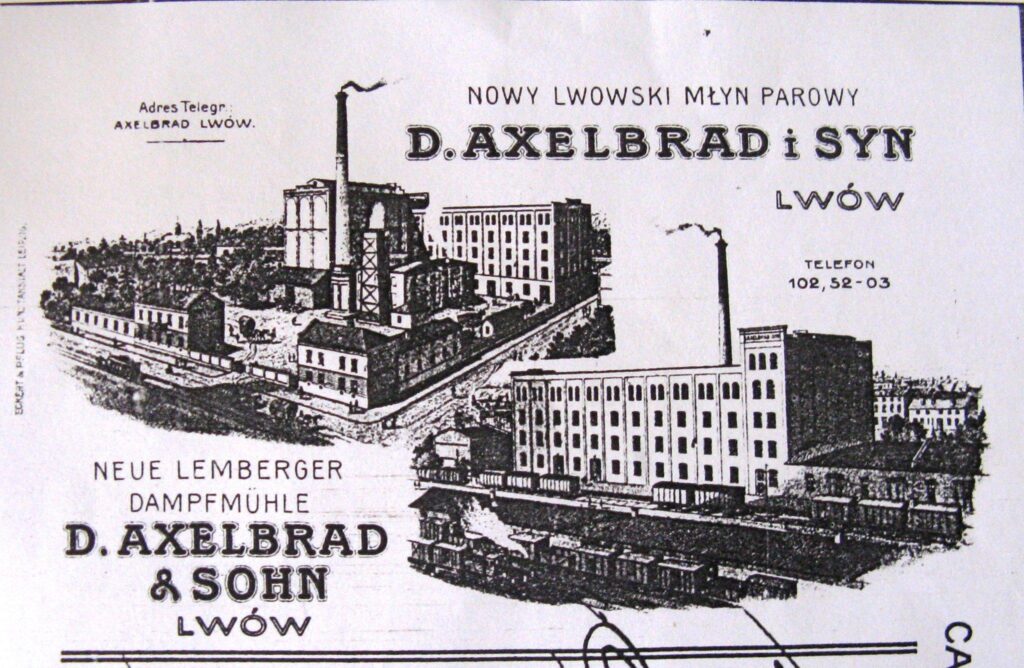
The grain went on to the Grain Square, where Hotel Lviv stands today. And from there – to the mills. One of the most important in Pidzamche was the Axelbrad steam mill. We are standing next to it.
It was founded at the end of the 19th century by the Jewish entrepreneur David Axelbrad. The first buildings went up in 1893. The firm was called “David Axelbrad and Son Steam Mill”. The son was Hermann – the mill’s second and last owner. By 1907 father and son were partners in the firm “New Lviv Steam Mill”. Between the wars it operated under Hermann’s name.
The mill was constantly modernised. In 1905 it was rebuilt by the architect Artur Schleyen, and in the early 1920s it was reconstructed and extended. From millstones to electricity within a few decades. At first grain was ground with millstones. Then roller mills arrived. Everything was driven by a steam engine, and in the 1930s an electric motor replaced it. Now not only wheat and rye were milled here, but also oats and barley.
When the Soviet authorities arrived, the mill was nationalised. Under the Nazi occupation it went on producing flour. Its owners, Hermann and Berta Axelbrad, were murdered in the Holocaust. Behind an industrial enterprise there is, once again, a particular family.
After the war a practically new mill was built here. It started work in January 1951 and processed 150 tonnes of grain a day. Today it is the Lviv Grain Products Plant, and its flour is sold under the Shchedryk brand.
But let us go back to the early 20th century. Next to the mill there were only warehouses and a flour wholesaler. From here the flour went to bakeries, and then to markets, shops, cafés and Lviv homes. Perhaps Axelbrad flour was used to bake the famous Kulykiv bread at Natan Schwarz’s bakery on Dzherelna Street – a rye bread of two joined loaves, with a crisp crust and nigella seeds, named after the town of Kulykiv near Lviv. There is no document to prove it. But the chain was exactly like that. Jewish families baked challah from flour, and matzah for Passover. For Passover matzah the flour was kept away from moisture so that the dough would not begin to ferment.
And one more thread. Next to the plant there is a small street called Karaimska. The Karaites are an indigenous people of Ukraine. Their faith recognises the Torah but not the Talmud. A Karaite community has lived in Halych for centuries, and today there is a museum of Karaite history and culture there. The tradition of making et ayaklak – a Karaite crescent-shaped mutton pasty – is inscribed on Ukraine’s National List of Intangible Cultural Heritage. Crisp pastry, chopped mutton, and mutton broth poured in through two small holes on top.
Grain from the surrounding villages. A toll gate. A marketplace. A Jewish entrepreneur’s mill. A bakery. And bread on the table of someone from an entirely different community. This is how Lviv worked – from field to table.