
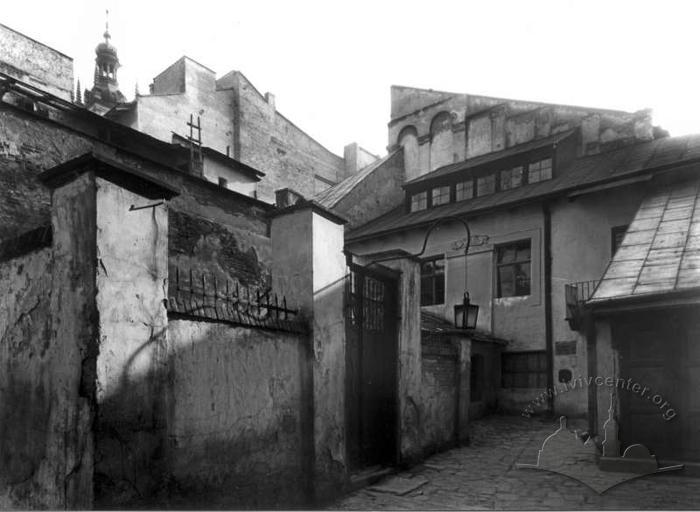
What we see is not a building. It is what is left of one. A few fragments of walls, a portal and emptiness where one of the oldest synagogues of Lviv once stood – the Golden Rose.
It was built in 1582 as the private synagogue of the merchant and financier Isaac Nachmanowicz, one of the wealthiest burghers of Lviv. It is said he was even the chief financier of King Stephen Báthory. It was built by Paweł Szczęśliwy (Pavlo Shchaslyvyi), a well-known Lviv master builder of the Renaissance. But the synagogue was built without the consent of the Catholic clergy. The archbishop complained to Rome, and construction stopped for 12 years. Only in 1595 were a vestibule and a women’s gallery added.
In 1603 the Lviv kahal – the self-governing body of the Jewish community – moved its regalia and its court here. The private synagogue became the city’s main synagogue. That same year a lawsuit began with the Jesuits, who wanted to take the building. The court even awarded it to them. But the entrance to the synagogue led through the house of Mordechai, Isaac’s son, and he simply refused to let the Jesuits into his courtyard. The synagogue remained with the community. And it remained so for almost two centuries – until 1801, when the new Great City Synagogue opened nearby.
The name Golden Rose did not appear at once. Later the synagogue was called Turei Zahav – “Golden Rows”, after the work of Rabbi David HaLevi Segal, who prayed here in the mid-17th century. Later Turei Zahav turned into Roiza Zahav – the Golden Rose. Linked to this name is the legend of Rose, Isaac Nachmanowicz’s daughter-in-law, who supposedly sacrificed herself to win the synagogue back for the community.
The synagogue was only the heart of a whole quarter. Around it stood the kahal house, a mikveh – a ritual bath, a Beit HaMidrash – a house of study, and a yeshiva. And a slaughterhouse, where shochtim – specially trained slaughterers – killed animals according to the rules of shechita so that the meat would be kosher. Most of these buildings are gone. Only information plaques in the former Jewish quarter recall them.
For a synagogue is not only a place of prayer. Its Hebrew name is Beit Knesset, “house of assembly”. People studied here, dealt with community affairs, and on Shabbat they prayed, discussed the weekly Torah portion and sat down at table together.
And here we return to our theme – food. The life of the community was ordered by kashrut, a system of rules about what may and may not be eaten. Permitted: the meat of cud-chewing, cloven-hoofed animals and of certain birds slaughtered according to the rules, and fish with fins and scales. Forbidden: pork, most seafood, and meat together with dairy. Whether a product was kosher was decided by rabbis. So the shechita, the butchers’ stalls, the synagogue and the house of study stood side by side for a reason. It was one system.
The Second World War cut this system off. In August 1941 the synagogue was looted, and in 1943 the Nazis blew it up. Of the Golden Rose, only fragments of walls and the portal remained.
Today this is the Space of Synagogues, opened in September 2016 to a concept by the Berlin architect Franz Reschke. The conserved remains of the Golden Rose, the marked foundations of the house of study, and the memorial “Perpetuation” – 39 stone steles. Many of them carry quotations from people who lived in Lviv and survived or witnessed the Holocaust. The quotations are in their original languages: Yiddish, Polish, Hebrew, German, Ukrainian. Because pre-war Lviv was multilingual.
Nothing has been deliberately rebuilt here. The space shows not the old synagogue but the place where it stood. Without decoration and without illusions. And it makes you feel how large the life that vanished here once was.