
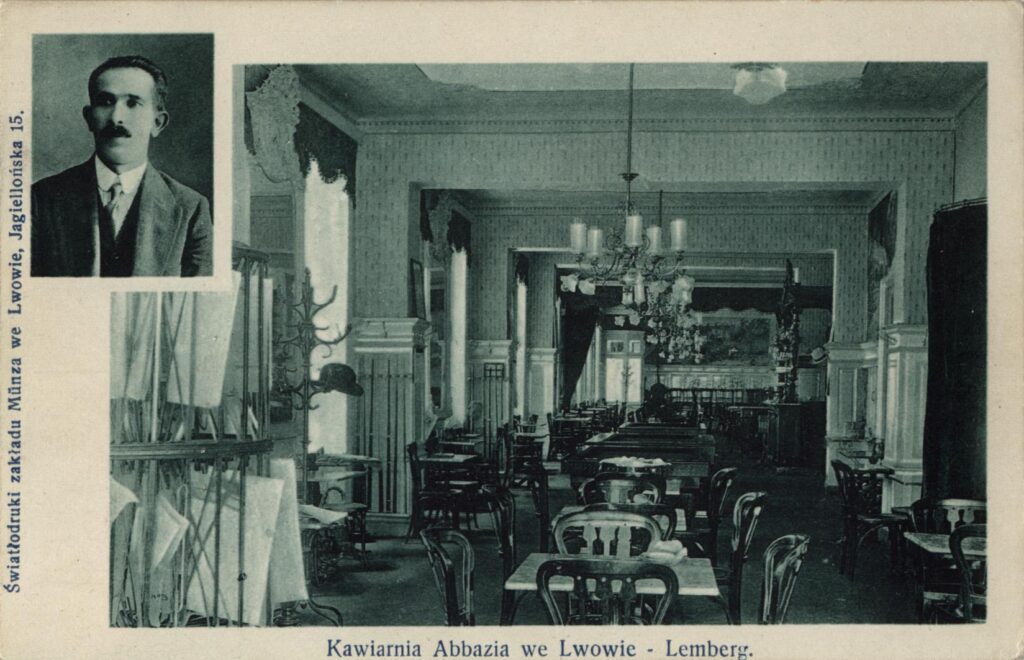
To do nothing. To sip coffee. To nibble a kipferl – a crescent roll. And simply to look out of a big window. That was a dream the poet Melech Ravitch once wrote down. And the window was here, in the Abbazia café.
We are at 33 Svobody Avenue. It used to be Karl Ludwig Street, the city’s main promenade. In Lviv, cafés were always more than places for coffee. They were newsrooms, clubs and meeting places all at once. People read newspapers, played cards, billiards and chess, made acquaintances and argued about politics and art.
The café opened around 1901 under the name Edison. Thomas Edison’s name then stood for progress and electricity. Later the café was renamed Abbazia – after a fashionable Austro-Hungarian resort on the Adriatic, today’s Opatija. Its clientele was almost exclusively Jewish and famous for its lively atmosphere.
Within a few years of the opening, Gershom Bader – a Zionist activist, journalist and publisher of Yiddish newspapers and magazines – was booking tables here for journalists and actors of Gimpel’s Jewish theatre. It was the first permanent Yiddish theatre in Europe. Bader became a mentor to many young writers. And the newspapers made at these tables were read throughout Jewish Galicia.
From 1905 Khone Wolfsthal – a musician of Gimpel’s theatre and a composer – played here regularly. With a small orchestra and singers he performed well-known arias and his own songs.
At the end of that same year an evening with a concert was held here. The guest of honour was Sholem Aleichem. He was staying in Lviv at the time, went to Gimpel’s theatre and later described his impressions in the novel “Wandering Stars” – a novel about the world of Yiddish theatre. Part of it is devoted to the Lviv theatre. Beside him sat local poets, actors and critics. Among them was the young poet Shmuel Yankev Imber, nephew of the author of “Hatikvah”, the future anthem of Israel. Thirty-seven years later Imber would be murdered in the Holocaust.
But most of the memories of Abbazia were left by Melech Ravitch – a poet, translator and a man who knew how to gather young people around him. He described the regulars: actors, writers, journalists. And that same dream – coffee, a kipferl and a big window. Behind all the talk of literature and politics lies a simple human wish: to sit by the window and watch the city.
The kipferl is a crescent-shaped pastry known all over Central Europe. For Lviv, which lived in the cultural space of Austria-Hungary, it was entirely at home.
Imagine this café. At one table – journalists. At another – actors. Someone is finishing an article, someone is arguing about a new play, and the musicians are getting ready to perform. All over a cup of coffee.
Melech Ravitch went on gathering writers around him. At the end of the 1920s the Yiddish magazine “Tsushtayer” was founded in Lviv. Among its creators were the writers Debora Vogel and Rachel Auerbach. But Abbazia did not live to see it. In November 1918, during the Polish-Ukrainian war, there was a pogrom against the Jews of Lviv. Shops and homes were looted, people were killed. Abbazia was wrecked too. It never recovered and closed in the mid-1920s.
Today this is an ordinary tenement house. But try to imagine: a big window, newspapers, coffee, a kipferl, music. Actors, journalists, poets and young people arguing about their future. Abbazia is a story not so much about coffee as about the people who met over it.