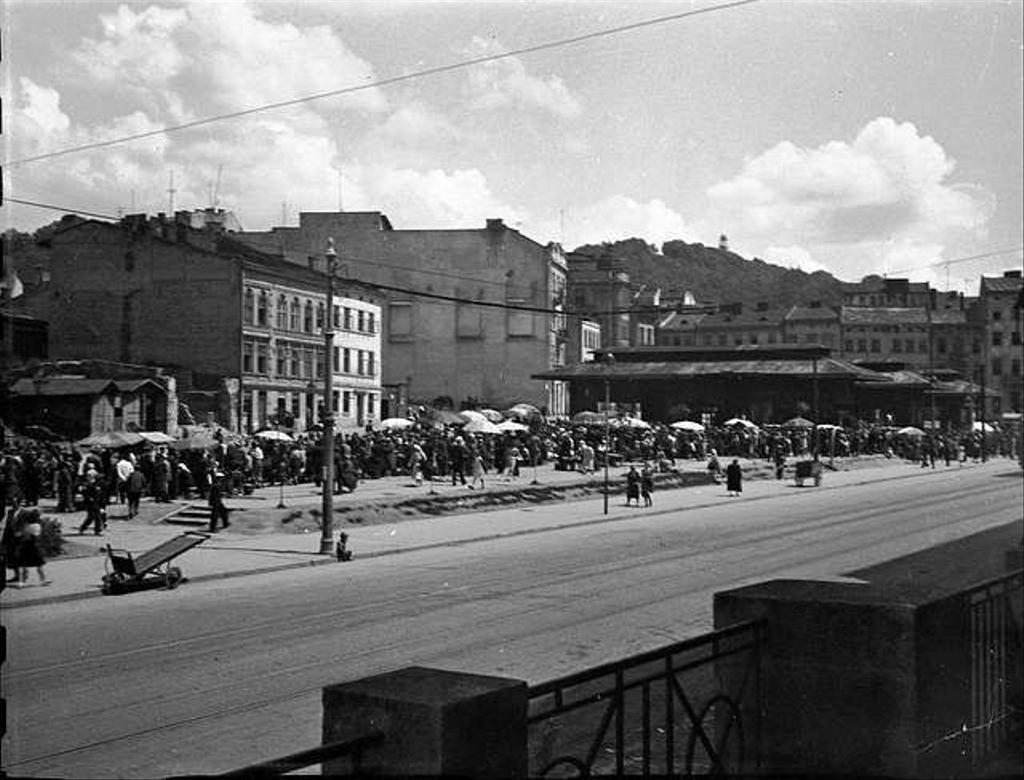
Night. Carts loaded with vegetables and fruit creak onto the square. It is still dark, but trading has already begun. Until five in the morning, owners of shops, taverns, restaurants, cake shops and bakeries buy their stock here. Only later do ordinary shoppers arrive. This is St Theodore Square, the heart of the area Lviv residents called Krakidaly.
Krakidaly was not one square or one market. Behind the Skarbek Theatre, today’s Zankovetska Theatre, a whole world of trade began. The Kraków bazaar, Grain Square, St Theodore Square and a web of streets, alleys, courtyards and passages of the former Kraków suburb. That is how the Lviv writer Witold Szolginia described Krakidaly.
Before the Second World War about 105,000 people lived in this part of the city. More than 62,000 of them were Jews.
St Theodore Square is one of the oldest in Lviv. The tenement houses around it date mostly from the second half of the 19th century. Almost all of them were rental buildings: the owners let out the flats and the ground floors. Downstairs, all around the square, there were shops, wholesalers and taverns. In the courtyards you can still see storerooms and cellars where goods were kept.
Second-hand goods were once traded here. Between the wars the square lived to a different schedule. At night and at dawn – wholesale trade in vegetables and fruit. Later – retail. Every Thursday and Friday poultry was sold here. Probably not by chance: these are the days before Shabbat.
There were more than 100 stalls on the square. Meat and fish were sold here – mostly carp and herring. And here is an interesting detail. According to a description of interwar Lviv, meat was bought mainly by poor Poles from Klepariv and Zamarstyniv. Jewish shoppers bought mostly fish. Carp is the basis of gefilte fish, and herring is one of the most characteristic foods of East European Jewish cuisine.
So this was not a separate “Jewish market”. It was a shared city market where each community bought its own food according to its own traditions. The traders were mostly Jewish merchants. Alongside them, Poles and Ukrainians from poorer suburbs and nearby towns bought and sold. There was a black market too: second-hand goods, goods of dubious origin and a very colourful crowd.
The Second World War broke this world. The Soviet authorities called informal trade speculation. The Nazis drove the Jews into the ghetto and, under threat of shooting, banned them from food markets.
After the war informal trade held on for a long time. But at the end of the 1950s the authorities “regulated” Krakidaly. The food market was moved from St Theodore Square to Kleparivska Street, where the Central Market had operated since 1947. Later it inherited the name “Krakivskyi”.
It stands on the site of the old Jewish cemetery, first mentioned in 1414. The Nazis and then the Soviet authorities destroyed it, and the gravestones were used for paving and for the walls of the new market. Isaac Nachmanowicz, founder of the Golden Rose synagogue, was buried here, as was the “Golden Rose” herself. Beneath the feet of shoppers at the Krakivskyi Market lie five centuries of Jewish Lviv.
On the site of the old Kraków bazaar behind the theatre, the Dobrobut market grew up in the 1990s. In its own way it continued the tradition of Krakidaly.
Today St Theodore Square is quiet. But this is where food once began its journey to the Lviv table: from cart to stall, from stall to kitchen.