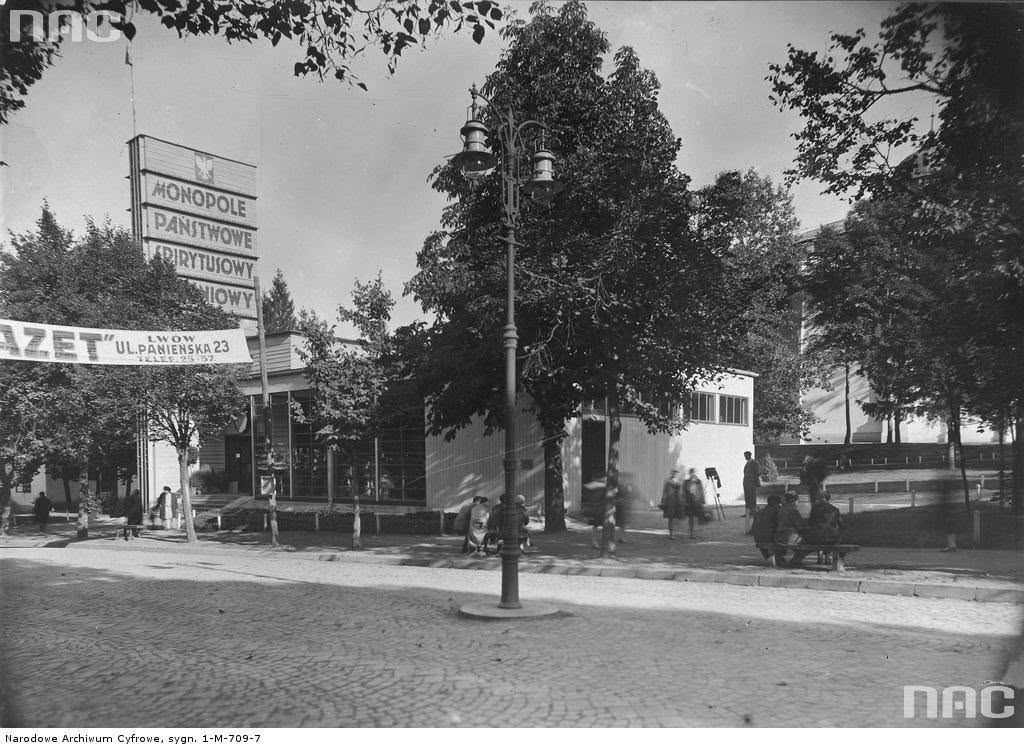
The best gift in Lviv has always been a box of chocolates or a bar of good chocolate. In interwar Lviv there was plenty to choose from. And one of the sweetest addresses in town is right here, at the corner of Sofii Yablonskoi Street – formerly Zavodska – and Tkatska Street. Today there are entrances to the factory from both streets.
In 1910 the HAZET sweets and chocolate factory began work here. It was founded by Jewish entrepreneurs Samuel Hammer and Wolf Zimand. The name is simply two letters as Poles pronounce them: “ha” and “zet”. H and Z – the initials of the founders’ surnames. Pidzamche was then an industrial district of Lviv: mills, canneries, distilleries – like the Kronik factory nearby. And confectionery factories.
The first buildings went up in 1910–1912. In the 1920s the factory was rebuilt, and the design is attributed to the architect Izrael-Mark Sobel. In 1925 electric motors arrived, along with machines for grinding chocolate mass and a cocoa mill. By 1937 the factory had an office building, two production buildings and warehouses. In the 1930s HAZET was one of the city’s largest confectioners: chocolate, marmalade, wafers, caramels, cakes and sweets. The most popular were “Caldorina” and “Tutti Frutti”.
HAZET also knew how to sell itself. In 1932, commissioned by the owners, the poet Emanuel Schlechter wrote the lyrics of an advertising tango – “Hazet – najsłodsze tango”, “HAZET, the sweetest tango”. It could be heard on dance floors and on Lviv radio. The song named “Caldorina” and “Tutti Frutti” outright. A sweet now had its own image, its own music and its own mood. Today we would call it branding.
Advertising was needed because the competition never slept. The main rival was the Branka factory on today’s Sheptytskykh Family Street. Its story began back in 1882 with Maurycy Brandstaetter’s steam-powered factory of sweets and honey cakes. He, too, was a Jewish entrepreneur. Branka made sweets, chocolate, cakes, wafers and even patented a method for making a thick chocolate filling. By the late 1930s more than 500 people worked there.
There were smaller players too, such as Jan Hoflinger’s factory. And there was a Ukrainian player in this market. Klementyna Avdykovych-Hlynska started with a sewing machine: after she was widowed, she sold it and began boiling fruit sweets. In 1924, with the support of Metropolitan Andrey Sheptytsky, her business became Fortuna Nova – one of the first Ukrainian confectionery factories in Galicia. Its best-known product was the chocolate box “A Sweet History of Ukraine”.
In 1939 everything changed. The Soviet authorities nationalised the factories. Branka became the Kirov factory, Fortuna Nova was merged into it, and HAZET turned into the Bolshevyk factory. In spring 1962 these factories were merged together with the one in Chortkiv. At first the new firm was called Chervona Troianda (“Red Rose”). From 3 August of the same year it was Svitoch.
The new factory renewed its equipment, part of it bought abroad. From the 1970s Lviv’s Svitoch was the city’s calling card, a scarce commodity and an essential part of any gift. After independence Svitoch became a joint-stock company, and in 1998 it joined the Nestlé group.
Now look at a Svitoch wrapper. There is a date on it: 1882. That is Branka’s year, not Svitoch’s. The modern brand has gathered several stories into one. Branka gave it the date. HAZET – the factory walls here in Pidzamche. And the Soviet era – the name.
Two Jewish entrepreneurs, another Jewish confectioner, a Ukrainian businesswoman with a metropolitan, a Soviet trust and a Swiss corporation. That is quite a story to fit into one chocolate bar.