
Roast wild boar with cabbage. Chopped lights. Tripe. Calf’s foot with horseradish. This menu was printed by the newspaper Dilo on 17 February 1901. And it was the menu of a Jewish restaurant.
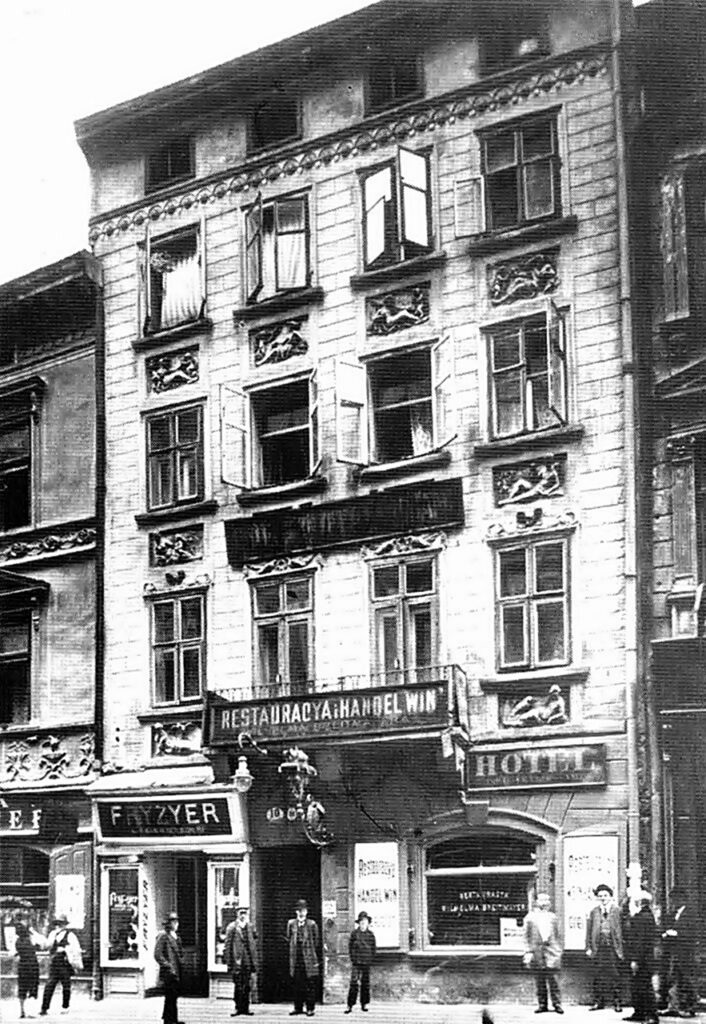
We are standing at 12 Shevska Street. Before the war it was called Trybunalska. From 1852 the restaurant “Under the Three Crowns” operated here. That name, however, was used only on the signboard. Lviv residents simply said “At Naftula’s” – after the owner, the Jewish entrepreneur Naftali Tepfer.
It was a democratic place: good food at moderate prices. People of very different means came here. Even the prices from that menu have survived: tripe cost 12 kreuzers, a sausage five, and a litre of wine from 40 kreuzers. Regulars praised the tripe, the sausages, the bigos and the Pilsner beer most of all.
Now back to the menu itself. Wild boar is pork. So the food “At Naftula’s” was not kosher. And this is an important detail for understanding Jewish Lviv. A Jewish restaurant did not necessarily mean a kosher one. Jewish entrepreneurs fed the whole city, and their establishments became part of a shared Lviv cuisine.
In 1901 Naftali died, and the restaurant passed to his son, Szymon-Michał Tepfer. An unusual man. A lawyer by training, and also an amateur painter, composer, memoirist, collector and patron. He supported young artists. He was friends with Ivan Trush and even offered him money to study in Munich.
Michał turned his father’s restaurant into a cultural venue. At his request the painters Roman Bratkowski and Mieczysław Piotrowski decorated the walls of the dining rooms with views of Lviv. On the first floor there was a separate room where artists argued about a new play, concert or book.
According to memoirs, impoverished artists sometimes paid Tepfer with their own works. He later donated part of his collection to the newly founded municipal picture gallery. So this restaurant fed not only its customers. It supported art as well.
And a new public came: painters, musicians, journalists, Polish and Ukrainian writers. Jan Kasprowicz, Stanisław Przybyszewski, Vasyl Stefanyk, Les Martovych.
Ivan Franko came here too. According to memoirs, it was here that he treated a young scholar from Dnipro Ukraine, Serhiy Yefremov, and said: “Naftula has good mead. Let’s try it – the conversation will be merrier.” Whether the conversation really became merrier, we can only guess.
There is another story: that Franko supposedly celebrated his wedding here. But Franko married in Kyiv, and there are no documents linking his wedding to this restaurant. So it is just a legend that attached itself to a popular place.
And here is a story the other way round. Bohdan Lepky, according to memoirs, did not go to Naftula’s himself. He left that “pleasure” to his friends Stefanyk and Martovych. Lepky preferred wine and liqueurs to beer. Every writer had his own tavern, and together they made up a whole map of Lviv’s bohemia.
The First World War brought this story to an end. During the Russian occupation of Lviv, Michał Tepfer was deported to Russia. He never returned to Lviv: in 1918 he moved to Poznań. And the restaurant later disappeared.
Almost nothing of it survives today. But the building is still standing. So let us try to imagine it differently. It smells of hot tripe. There is wine and beer on the tables. Someone is leafing through a newspaper. At the next table people argue about yesterday’s play. And somewhere in a corner Franko is pouring mead for Yefremov.
This building reminds us what old Lviv was like: a Jewish entrepreneur opens a place, and the city makes it its own. Lviv even chose the name itself. Not “Under the Three Crowns”, but simply – “At Naftula’s”.