
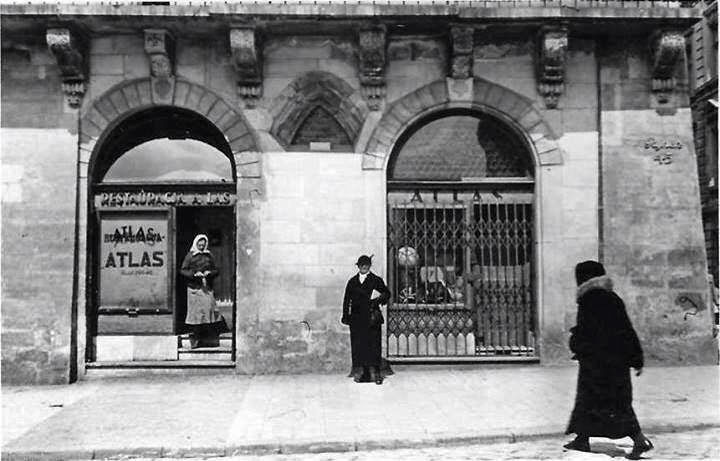
We are standing on Rynok Square, by house number 45. Everyone in Lviv knows the name Atlas. But few remember that it is the surname of a real person.
Mojżesz Lejb Atlas was a Jewish businessman who traded in alcohol. The start of his business is traditionally dated to 1871. At first drinks were sold here. Later a restaurant and a café appeared. And gradually the place became one of the best known in Lviv.
But the greatest fame came through another man – Atlas’s son-in-law, Edward Tarlerski. Lviv knew him simply as Pan Edzio. It was under him that Atlas became the place the city remembers: bohemian, a little rowdy and very Lviv.
Pan Edzio was an expert in nalewka – sweet cordials steeped on berries or fruit. According to memoirs, he created about twelve kinds of them. The house drinks were served here: “Atlasówka”, “Śmietankówka” and “Nemówka”. The last was named after a regular guest – the poet and satirist Henryk Zbierzchowski, who wrote under the pen name “Nemo”. A writer came here as a guest, and his name ended up on the drinks list.
Because the main thing at Atlas was not in the glass. Writers, artists, journalists and actors came here. Jan Kasprowicz, Marian Hemar, Bruno Schulz, Józef Wittlin. And painters – Oleksa Novakivskyi, Kazimierz Sichulski. Note this: Hemar, Schulz and Wittlin were writers of Jewish origin who wrote in Polish. Novakivskyi was a Ukrainian painter. Atlas brought together not only different professions but also different languages and communities.
Guests left their mark right on the walls: drawings, caricatures, inscriptions, jokes. An artist might sit at a table talking to friends, then pick up a pencil and draw something straight on the wall. The “Artistic” room was special – artists left their works there. And in the “Barrel” room guests sat on real barrels. The history of Atlas was written not in the menu but on its walls.
Imagine an evening here. Someone is arguing about a new book. Someone is retelling the latest city joke. Someone is drawing on the wall. And the waiter is already bringing the next nalewka. Humorous menus in verse were even written for the guests, and Zbierzchowski wrote comic pieces about Atlas.
Of course, a place like this attracted legends. They say the toilet here was paid, and Lviv residents would excuse themselves by saying: “I’m off to see Pan Edzio.” They also say that Jan Kasprowicz sat here for a day and a half and left a drawing on the wall – a rather indecent one. There are no documents to confirm this. But does it really matter which detail is true? This is how the city remembered Atlas – as a place of free, cheerful, slightly scandalous life. Atlas appears in literature, songs and humorous writing. For interwar Lviv its name became part of the city’s cultural code.
Why does this story matter for the Jewish culinary heritage of Lviv? Because Jewish, Polish and Ukrainian cuisines did not live in separate worlds in this city. Atlas shows this well.
Its story begins with a Jewish businessman and the alcohol trade in the very centre of the city. And it ends with a place where everyone came. A writer, a painter, a journalist, a merchant or simply a Lviv resident could sit at one table here. Food and drink were a reason to meet. People came here to talk, make deals, hear the news or just spend the evening. A shop selling cordials became a cultural space in which the memory of a whole city took shape. What was sold here was not only food and drink. It was the atmosphere of Lviv, which several generations still remember.