
1894. Lviv, the General National Exhibition. Among the pavilions towers a giant carafe. It is not a sculpture. It is an advertisement for a vodka factory – and the most interesting and most visited pavilion of the exhibition.
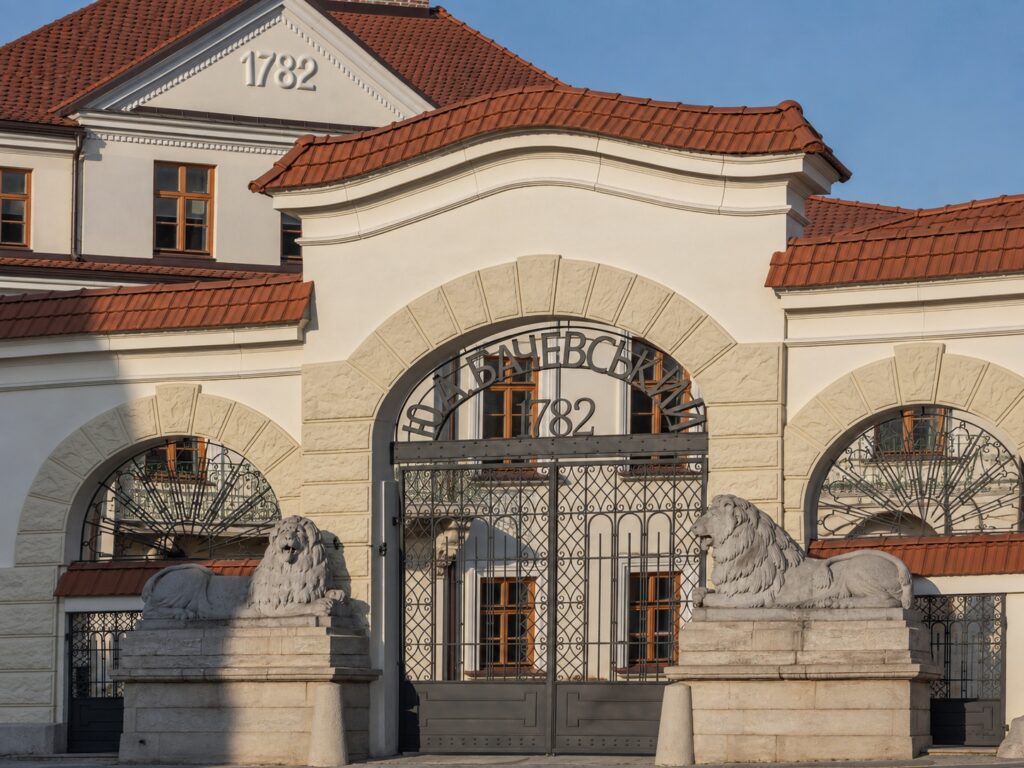
The factory stood here, on the former Zhovkva road. But its story began back in 1782 – and not in Lviv. That date, 1782, can still be seen on the building of the firm’s former office. The Jewish merchant Leib Baczeles then opened a small distillery in Wybranówka, near Bibrka. His son, Leopold Maximilian, moved the business closer to Lviv, to Znesinnia. In 1810 the company received the status of a privileged provincial factory.
The family also took part in the life of the Jewish community. Majer Baczeles was one of the administrators of the committee for building the progressive Tempel synagogue. But later the family converted to Christianity, and the name Baczeles became the Polish Baczewski. This, too, is part of Lviv’s Jewish history: a story of assimilation.
The Baczewskis staked everything on quality. As early as the 1830s the factory introduced a double rectification system based on the technology of the Irishman Aeneas Coffey. The spirit became cleaner and the drinks smoother. Vodkas, liqueurs, fruit cordials, rum, cognac, bitters. Among them krupnik and the rosolis we have already met.
Under Józef Adam Baczewski, a technologist by training, the factory became a large industrial enterprise. In 1876 it received the title of Imperial and Royal Purveyor to the Court, and later the Baczewskis bought the nearby Cielecki palace and adapted it for the factory. The Baczewskis also understood that a good product has to be sold. Recognisable carafes, labels, advertising. Export drinks were poured not into bottles but into crystal carafes. The bottle had to work for the firm before it was even uncorked. And in 1926, at the Eastern Trade Fair, the Baczewskis put up their own advertising tower. Today we would call it branding. Baczewski products collected awards at international exhibitions – from Vienna and Amsterdam to London and Paris. At the 1900 World’s Fair in Paris, reportedly, even the highest one.
In 1911 Józef Adam died, and his sons inherited the factory. Between the wars the Baczewskis deliberately limited production to keep up price and quality. Even so, the factory’s capacity reached about 336 hectolitres – up to four and a half railway wagons of goods a day. The label “J. A. Baczewski – Lwów” was known far beyond Poland. Baczewski drinks were served on the transatlantic liners Polonia and Piłsudski, and liqueurs were flown to Paris, Vienna and Prague. At the same time these bottles stood in Lviv restaurants and cafés, on the tables of people from different communities. A few hundred metres from here was the Kronik factory, which made kosher drinks for the Jewish community. And here – a factory with Jewish roots that worked for the whole city and the whole world. Two different stories on one street.
In 1939 that era ended. In the first days of the war the factory was destroyed by German bombs. The Soviet authorities cleared the ruins. In 1940 the NKVD arrested the cousins Stefan and Adam Baczewski and sent them to the mines of the Donbas. Both died there.
The factory was never revived in Lviv. But the brand survived the war. It was re-established in Vienna with the participation of the Viennese Gessler family, and the bottles still read: “Fondée 1782 – Lwów”. “Founded in 1782. Lviv.”
So the label on an old bottle is not just the producer’s name. It is a small history of the city: a Jewish merchant with a distillery, a family that became Polish, and a product that set out from Lviv into the world.